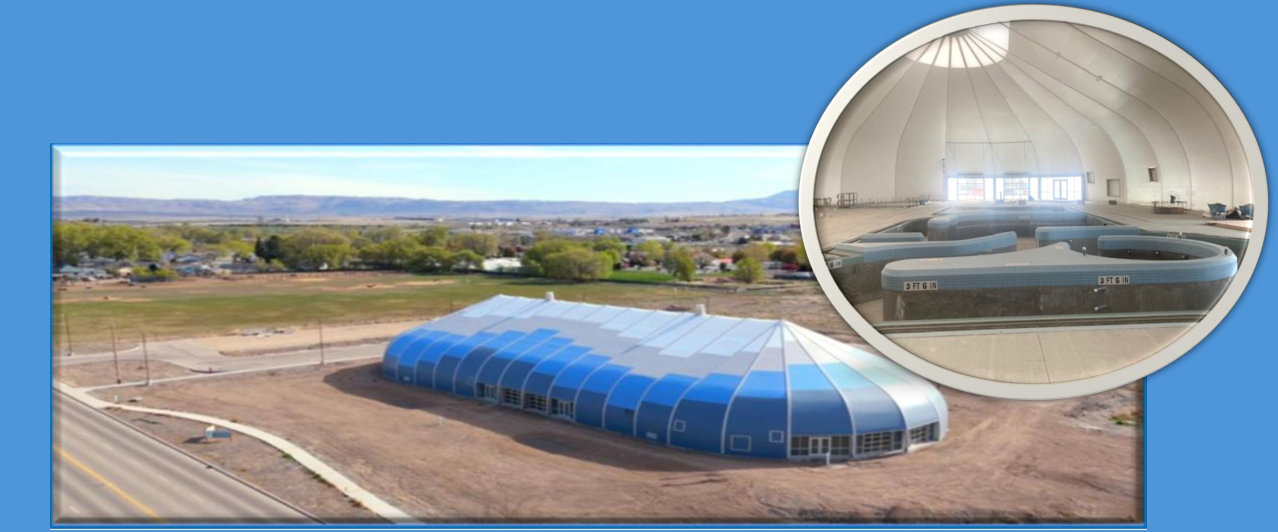
Understanding that the WECRD was given a mandate from the people to construct a multi-purpose, year-round, family recreation/community activity facility, the directors moved forward with the concept. A project of this magnitude requires careful preparation, thoughtful decision-making, and excellence in coordination of a multi-faceted project.
The WECRD sought funding of the WECRD Recreation Center with a step-by-step approach to secure construction funds and provide for sustainability of the facility.
Tax dollars were saved from revenue generated. Methods: First, the Directors set the example of volunteer service and as such receive no pay or reimbursement from the District. Second, engage an adequate staff to accomplish the duties of the District whether they are employees, contractors, or volunteers.
Conducted a capital campaign feasibility study to examine the achievability of completing a successful capital campaign to finance the BRC facility. The proposed facility would have been approximately 80,000 square feet at a cost of approximately $10M.
The WECRD interviewed three firms and selected a firm respected and experienced in YMCA fundraising.
WECRD invested tax revenues in Local Government Investment Pool (LGIP). The LGIP is a low-risk highly liquid investment tool used by governments within Idaho to earn interest and to provide quick accessibility
Applied for KROC Foundation Funds made available nationally through Salvation Army regional oversight. The WECRD competed against six other Idaho communities: Meridian, Boise, Twin Falls, Pocatello, Idaho Falls and Coeur d’Alene for a Joan Kroc Community Center. Despite having and presenting the most practicable and complete proposal and meeting all guidelines established by the Salvation Army the WECRD was passed over in favor of Coeur d’Alene. Coming in second to Coeur d’Alene, the greater Mountain Home community, which put tremendous effort behind the WECRD (over 1000 letters of support), was sorely disappointed. Second place in the competition did not provide any monetary benefit to the WECRD.
Purchased 20 acres for the WECRD Recreation Center. Several parcels were evaluated based on a matrix designed by the Directors to ensure the parcel best suited to the purpose was selected. The land owned by the WECRD is within walking distance of over 2000 elementary – high school students, is easily accessible from American Legion, a main traffic artery, is visible from I84, is suitable for expected facility expansion and is large enough to accommodate partnerships with like-minded agencies. Prior to purchase the WECRD conducted a survey, Level 1 Environmental Review, Corp of Engineer determination, Elmore County Planning and Zoning review and City of Mountain Home ‘Area of Impact zoning review.
Formed a 501(c) 3 Foundation to support the District as donations are received. The Recreation Foundation of Elmore County was formed in 2005.
Apply for Federal Appropriations (FA) through the Idaho Congressional delegation. FA application of 2005 not funded, but WECRD is encouraged to reapply. FA application of 2006 not funded, but WECRD encouraged to reapply. FA application of 2007 is funded for fiscal year 2008 in the amount of $294,000. FA Application for 2008 – no decision.
Idaho’s congressional delegation has strongly supported the WECRD FA application.
“…I am convinced that this (WECRD) project has tremendous merit and would be a welcome addition to the Mountain Home region. The recreation center envisioned in your submission would help to improve the health of the region’s citizens, provide a community gathering place and attract new businesses and economic opportunities to the area. In addition, the facility would provide a convenient exercise facility for the many active-duty servicemen and women living in Elmore County as well as the thousands of veterans who reside in the region.
The WECRD is securing the FY 2008 appropriations funding through HUD. In doing so the WECRD is completing several HUD mandates prior to release of funds: environmental review through the assistance of Bionomics; surveying through the assistance of Waite Land Surveying; architectural and engineering specifications through the assistance of Olson Architects; WECRD accounting system of federal funds through the efforts of Judy Erwin, WECRD treasurer; WECRD general coordination of FA efforts through the efforts of Betty Ashcraft, Recreation Foundation of Elmore County member and Mollie Marsh WECRD Director.
WECRD changed from a $34.50 annual per-household fee tax assessment (in effect at the same rate from 2001-2007) to a general tax levy assessment. The FY 2008 WECRD Budget submitted to Elmore County in September 2007 (to be received 2008) was determined at .0006% of the net assessed value of property. The FY 2009 Budget submitted to Elmore County in September 2008 (to be received 2009) was determined at .0006% of the net assessed value of property.
Rationale for change:
Under the per-household fee (2001-2007) all WECRD property tax owed was not assessed to property owners, rather that amount of tax was divided by only households (households bore the burden of paying 100 percent of all taxes owed) – owners of property (businesses) were not taxed under the per-household fee.
Over 13 percent of 2009 WECRD tax revenue (over $50,000) will be generated from out-of-district land owners.
WECRD decided to examine the viability of constructing a 20,000 square foot “Stage 1 of the WECRD Recreation Center with the revenue on hand (LGIP, Federal Appropriations and 2009 tax revenues) so that the facility would be built debt-free. WECRD Recreation Center components being considered are aquatics (warm water therapy and cool water exercise pools), open space for programming for all ages and a few small areas for office, flex rooms, etc. Olson Architects has prepared preliminary design and costs. Green Play, a recreational analysis firm, provided a draft of operating expenses and revenue generation. WECRD compiled information for WECRD Recreation Center business plan.
WECRD continues to evaluate constructing "Stage 1" of the WECRD Recreation Center with revenue on hand.
The WECRD Board received the following confirmation from the US Dept. of Housing and Urban Development: “The following project was specified in the Congressional Record to receive grant funding in the amount of $294,000 for planning, design, and construction of an energy efficient multi-use community center.”
Bionomics Environmental, Inc. was hired to complete a HUD mandated Environmental Assessment of the WECRD property prior to receiving authorized access to federally appropriated funds.
Waite Land Surveying was hired to complete the surveying portion of the Environmental Assessment.
Director Doug Belt resigned from the WECRD Board citing lack of time. Jana Borgholthaus was appointed to fill the position vacated by Mr. Belt in sub-district II.
2009
Director Dee Pate resigned from the WECRD Board citing health issues. Marsha Sellers was appointed to replace Mrs. Pate as Director from sub-district I.
The Treasure Valley Family YMCA was hired to provide consulting services for the continuation of the planning phase for a community center/potential Family YMCA in the Mountain Home area. Services included: formation of a Community Leadership Development Committee and sub-committees, Community Input Process, Facility Components Review/Development, Marketing, Financial Proforma Review/Development
Bionomics Environmental, Inc. completed and submitted Environmental Assessment to HUD.
The Directors declined the allowable 3% tax increase in the budget proposal for 2009-2010.
The WECRD was given notice that the building they were leasing was to be razed for new construction. The office then moved into its new location at 245 E. 6th South. New office meeting rooms were made available for free use by not-for-profit organizations.
The WECRD received confirmation from HUD for the approval of a Special Project Grant in the amount of $285,000.
Community leaders were invited to a luncheon meeting as the first step in creating the Community Leadership Development Committee of the Treasure Valley Family YMCA. Creation of the CLDC was the beginning of a possible collaboration with the YMCA.
2010
The CLDC/YMCA released its Survey in March of 2010. (See CLDC/YMCA tab)
Leaders from the YMCA conducted a Town Hall Meeting to explain to the community the process, objectives and progress of the CLDC. (See CLDC/YMCA tab)
The WECRD Board of Directors established the Let’s Play grant program to help support youth recreation programs in the Mountain Home area.
In May, HUD authorized use of federal funds allocated in 2008 and 2009 to construct a recreation center based on review of submitted Environmental Assessment.
Spring and summer of 2010 the WECRD moved savings held in the Local Government Investment Pool to certificates of deposit held in local banks.
The city Planning and Zoning Commission approved the request to annex the WECRD property into the City of Mountain Home. In June the City of Mountain Home finalized the ordinance to approve the annexation and rezoning request to annex the WECRD property of just less than 20 acres of land along South 18th East.
The independent research firm of Strategic Research Associates of 2010 released the results of the Market Study conducted during that summer. (See CLDC/YMCA tab)
The Directors declined the allowable 3% tax increase in the budget proposal for 2010-2011.
In November, the WECRD conducted an election for the positions of Director of both sub-districts I and II. Sub-District I: Marsha Sellers, incumbent; Judy Mayne, challenger. Sub-District II: Jana Borgholthaus, incumbent; Art Nelson, challenger. Both incumbents were re-elected in an election that drew over 2,600 voters.
2011
January 2011, Directors Marsha Sellers and Jana Borgholthaus were sworn in as duly-elected directors of the WECRD.
David Duro and Jim Everett from the Treasure Valley Family YMCA conducted a Town Hall meeting outlining the next steps in the collaboration process between the “Y” and WECRD to bring a recreation center to Mountain Home.
The Community Leadership Development Committee (CLDC) completed its task for the YMCA and analyzed the survey results.
The Treasure Valley Family YMCA was hired to continue consultation for the next steps in the community recreation facility planning process. Steps to complete included: formation of a Capital Campaign Committee, selection of a consulting firm to complete a Capital Campaign Feasibility Study and evaluation of the results of the study.